카테고리 없음
Regarding the martial law of President Yoon Seok-yeol of the Republic of Korea
Eng Social
2025. 1. 2. 23:15
반응형
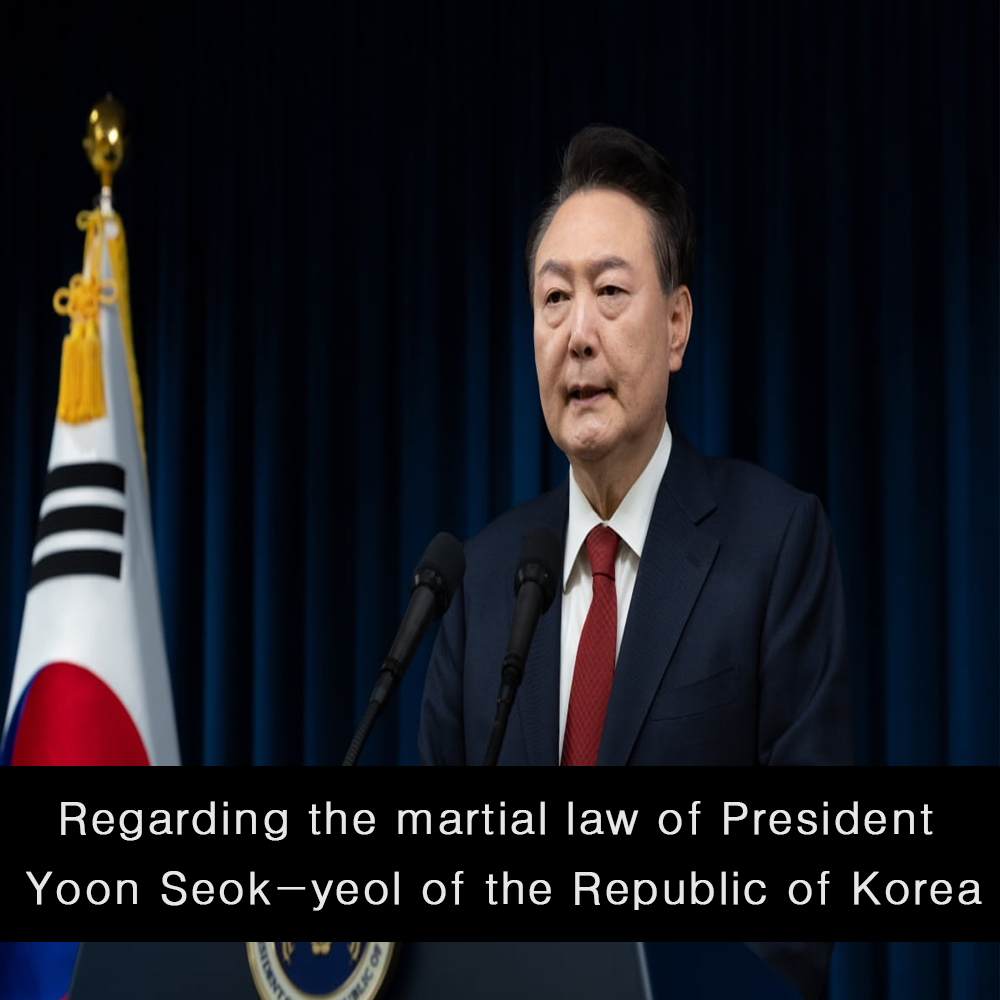
Regarding the martial law of President Yoon Seok-yeol of the Republic of Korea
President Yoon Suk Yeol's Actions Regarding Martial Law on December 3, 2024
On December 3, 2024, South Korean President Yoon Suk Yeol made a historic and controversial decision to declare emergency martial law. This marked the first such declaration in South Korea since 1980.
1. Declaration of Martial Law
- In a surprise late-night televised address at 10:30 p.m. KST, President Yoon announced the imposition of emergency martial law.
- He accused the opposition Democratic Party of Korea (DPK) of engaging in "anti-state activities" and paralyzing government operations.
- Yoon justified the martial law as a measure to eradicate pro-North Korean forces and protect South Korea’s constitutional democracy from what he described as a "national disaster" caused by political deadlock.
2. Key Motivations Behind the Declaration
- The opposition-controlled National Assembly had recently passed a downsized budget bill and initiated impeachment motions against key officials, including a state auditor and the chief prosecutor.
- Yoon claimed that these actions undermined public safety, national security, and governance, accusing the opposition of fostering chaos and turning South Korea into a "drug haven".
- He vowed to rebuild a "free Republic of Korea" and urged citizens to trust his leadership despite potential inconveniences.
3. Immediate Measures Under Martial Law
- All political activities, including protests, rallies, and demonstrations, were banned.
- The Martial Law Command was authorized to oversee media operations and restrict freedoms such as speech, publication, assembly, and association.
- Military forces were deployed to enforce these measures, including securing access to the National Assembly.
4. Backlash from Opposition and Public
- The opposition DPK condemned the declaration as unconstitutional and convened an emergency session at the National Assembly.
- Protesters gathered outside the parliamentary grounds to block military access.
- DPK leader Lee Jae-myung called for citizens to safeguard democracy and declared that Yoon had betrayed the people.
5. Reversal of Martial Law
- Just hours after the declaration, at around 1:00 a.m. on December 4, the National Assembly held an emergency vote.
- With unanimous approval from 190 lawmakers present, the parliament demanded the immediate lifting of martial law.
- Under South Korea’s Constitution, martial law must be revoked if a parliamentary majority opposes it. Yoon complied with this mandate early on December.
6. Domestic and International Reactions
- Domestically, Yoon’s approval ratings—already low—faced further scrutiny as many viewed his actions as an overreach of authority.
- Internationally, allies like the United States expressed "grave concern" but welcomed the swift reversal of martial law. U.S. officials emphasized their hope for peaceful resolution in accordance with democratic principles.
7. Long-Term Implications
- The declaration has intensified political polarization in South Korea.
- Critics argue that it reflects Yoon's struggle to navigate governance with an opposition-controlled parliament.
- The incident has raised questions about democratic stability in South Korea amid ongoing political conflicts.
Conclusion
President Yoon Suk Yeol’s declaration of martial law on December 3, 2024, was a bold yet controversial move that highlighted deep political divisions in South Korea. While it was swiftly overturned by parliamentary action, its implications for governance, public trust, and international relations remain significant. This event serves as a critical moment in South Korea's modern political history.
반응형